
PLANNING TIPS · BJÖRN VW EVENTS
Beach Wedding Planning Tips: What No One Tells You
By Björn VW · June 2026
A beach wedding sounds like the easiest decision you'll ever make. The venue is already beautiful. No centerpieces competing with the view. No stuffy ballroom. Just salt air, soft light, and the sound of waves as your soundtrack.

And then you start actually planning one.

Beach weddings are genuinely magical — but they are also among the most logistically complex weddings you can plan. The couples who love the process are almost always the ones who knew what they were getting into. This guide covers what experienced planners tell their clients on day one: the permits, the wind, the tides, the infrastructure, and the dozen other things that most beach wedding articles never mention.
Public beach vs. private beach: the first decision that changes everything
Before you do anything else — before you tour venues, before you hire a photographer, before you pin a single image — you need to understand that "beach wedding" actually describes two completely different planning paths.
Public beaches are accessible to everyone, which means your wedding shares the space with sunbathers, joggers, and curious strangers unless you secure an exclusive-use permit. You'll apply through the local municipality or parks department, and the rules vary dramatically by location. Some cities are welcoming and straightforward. Others restrict amplified sound, limit guest counts, prohibit tents or structures, and require you to restore the beach to its original condition within hours of the event. Permit lead times range from a few weeks to six months or more for popular beaches in peak season.
Private beaches — resort properties, private estates, exclusive venue sites — handle permitting internally and give you much more control over the space. You won't share it with strangers. You'll likely have access to power, restrooms, and sometimes a covered pavilion. The trade-off is cost: private beach venues typically charge significantly more than renting a permit for a public stretch of sand.
Neither is inherently better. But they require completely different planning approaches, vendor conversations, and budget allocations. Decide which path you're on before anything else, because it shapes every decision that follows.Permits, sound rules, and red tape — start here, not last
This is the section most beach wedding guides bury in a sidebar or skip entirely. Don't make that mistake.
If you're getting married on a public beach, your permit is not a formality — it's the foundation of your entire event. Apply late and you may find your preferred date unavailable, your guest count capped lower than you planned, or your sound system prohibited entirely.
Here's what you need to research and secure early:
Ceremony permit. Contact the municipality, county parks department, or state parks office that manages your beach. Ask specifically: what is the maximum guest count for a permitted event, what structures are allowed (chairs, arbors, tents), and what is the typical processing time. Many popular beaches in coastal states book permits 3–6 months out for summer Saturdays.
Sound ordinance. This one surprises almost every couple. Many public beaches have strict decibel limits or prohibit amplified sound entirely after a certain hour — or at all. If you're envisioning a live band or a DJ setup on the sand, confirm this is permitted before you book either vendor. In some locations, you can have a small PA system for the officiant's microphone but nothing more.
Fire and open flame rules. Tiki torches, candles, and s'more stations are beloved beach wedding details. Many beaches prohibit all open flames. Check before you design your aesthetic around something you may not be able to have.
Alcohol permits. Serving alcohol on a public beach often requires a separate permit from your event permit. This is easy to overlook and can create real problems if you're caught without one.
Start the permit process the moment you identify your beach. Everything else — vendors, invitations, décor — can flex around permit approval. Your date and guest count cannot.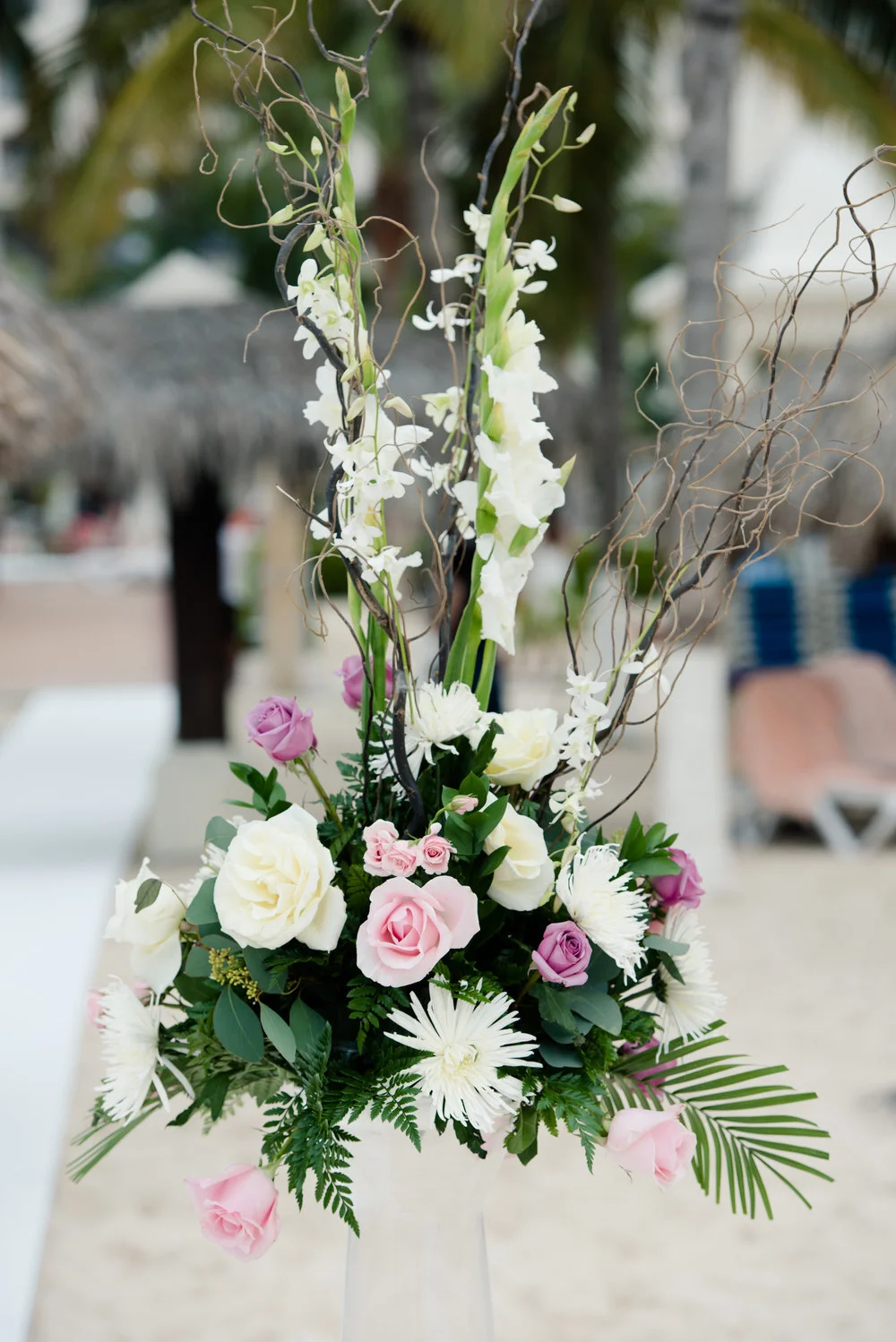
Wind: the thing that ruins more beach weddings than rain
Everyone worries about rain. Experienced beach wedding planners worry about wind.Wind is constant, unpredictable, and affects almost every element of your wedding day in ways you won't anticipate until you're standing on the beach on a 20-knot afternoon watching your ceremony programs sail into the ocean.Here's how to plan around it:
Florals. Tall arrangements topple. Loose petals scatter. Design with wind in mind: low, compact centerpieces work far better than tall vases. Weighted vessels — stone, concrete, heavy ceramic — hold their position. Avoid anything that relies on height or delicacy.
Paper. Loose programs, menus, and escort cards are a liability. Clip programs to fans (guests will appreciate these in the heat anyway). Use weighted holders for menus. For seating, consider a printed display board instead of individual cards.
Microphones. A single stand-mounted microphone is a wind disaster waiting to happen — it picks up every gust and your officiant's words get lost. Invest in a lapel or headset microphone system for the officiant, and clip mics or a handheld for anyone doing readings.
The veil. Long veils in coastal wind are a photography gamble. Some couples love the ethereal flying-veil shots; others spend their entire ceremony fighting fabric. Have an honest conversation with your photographer about what will actually be manageable. A shorter veil, a veil clip, or simply skipping the veil are all valid choices.
Ceremony orientation. Position your guests so the wind is at their backs, not in their faces. Your officiant and couple face into the wind while guests sit comfortably. This also helps with microphone audio — wind noise is captured behind the mic rather than directly into it.
Check Windy.com. This is the tool planners actually use. It gives hour-by-hour wind forecasts with direction and speed, far more granular than a standard weather app. Check it obsessively in the week leading up to your wedding.
Timing: tides, golden hour, and heat
Three factors unique to beach weddings will significantly affect your timeline — and most couples don't think about any of them until it's too late to adjust.
Tides. The beach you visit at low tide and the beach you visit at high tide can look completely different. High tide can reduce your ceremony space by half, push water uncomfortably close to your seating, or in extreme cases make your intended spot unusable. Pull the tide chart for your exact wedding date (tide-forecast.com and NOAA both provide free charts by location) and check when high tide peaks relative to your ceremony time. Ideally, schedule your ceremony around low tide — you get more beach, better photos, and no anxious checking of the waterline.
Golden hour. Photographers love beach golden hour, and rightly so — the light is extraordinary. But if your guests are seated facing west for a late-afternoon ceremony, they'll be looking directly into the sun. Think carefully about the orientation of your ceremony setup relative to the sun's position at your planned start time. West-facing ceremonies work beautifully in the morning; east-facing setups work better in the afternoon.
Heat. An exposed beach in the summer sun is a genuinely uncomfortable place to sit in formal clothing. Noon and early afternoon ceremonies are often brutal for guests. Late afternoon (after 4pm) and evening ceremonies are cooler, more comfortable, and better lit. If you must hold a daytime ceremony in summer, keep it short, have water available, and provide shade wherever possible — even a pergola or simple canopy makes a meaningful difference.
Power, rentals, and infrastructure that doesn't exist
A beach is a beautiful, blank canvas. It is also a location with no electrical outlets, no running water, no climate control, and no restrooms.Every convenience you want at your beach wedding has to be brought in, powered, and managed. Here's what that actually means:Generators. For any amplified sound, lighting, catering equipment, or refrigeration, you'll need a generator. Rental companies can advise on the right size for your event (measured in kilowatts — a typical beach ceremony and reception with lighting and sound needs 20–30kW minimum). Position the generator as far from the ceremony area as your cable run allows — they're not quiet. Discuss this placement with your rental company and sound vendor together.
Portable restrooms. Yes, really. Even if a public restroom exists nearby, it won't be adequate for your guest count, and it won't be where you want guests wandering during cocktail hour. Luxury restroom trailers (climate-controlled, with running water, mirrors, and real toilets) are a significant step up from standard porta-potties and worth the extra cost for a wedding. Book these early — they're surprisingly popular and often sell out for summer weekends.
Tents and shade structures. If you want a tent, confirm it's permitted at your location before you book one. For beach use, choose a tent specifically rated for high-wind environments — standard frame tents are not designed for coastal conditions. Your rental company should be able to advise. Tent stakes behave differently in sand than in grass; experienced companies use specialized anchoring systems (weighted barrels, sand screws) rather than standard ground stakes.
Chairs and tables. Standard event chair legs sink into sand. Look for rental companies that have experience with beach setups — they'll use boards or platforms beneath chair and table legs to create a stable surface. This is a small detail that makes a real difference in how your event looks and functions.
Lighting. String lights require poles to hang from (there are none on a beach). Lanterns need to be weighted. Any uplighting needs power. Plan your lighting scheme alongside your generator and rental vendor, not separately.
Your rain and wind backup plan (you must have one)
This is non-negotiable. Not optional. Not "we'll figure it out if it happens."Every outdoor wedding needs a backup plan, and beach weddings need one more urgently than most. You're exposed to the elements from every direction, and you're often far from any indoor space that could absorb your event.Identify your backup venue before you book your beach. This is the order of operations. Your backup could be a nearby resort ballroom, a restaurant with a private event space, a community hall — anything that can hold your guest count and is logistically adjacent to your caterer, your rentals, and your other vendors. Confirm with the backup venue that they can hold a date on standby and what the fee for that hold is.
Build weather clauses into your vendor contracts. Ask every vendor — venue, caterer, florist, rental company — what their policy is if the event moves to the backup location. Make sure setup fees, transportation, and any additional labor costs are spelled out. Surprises on your wedding day are not what you want.
Decide your trigger point in advance. "We'll see how the morning looks" is not a plan — it creates anxiety and puts your vendors in an impossible position. Discuss with your planner or coordinator: if the forecast shows X conditions at 48 hours out, we move. Having a clear threshold removes the emotional weight of making that call in the moment.
Communicate quickly. Have a method ready to notify all guests if the location changes — a wedding website update, a text chain, a WhatsApp group. Designate someone other than you to manage this communication on the day so you're not on your phone during your own wedding.
What to tell your guests (and what they'll always ask)
Guest communication for a beach wedding requires a little more thought than a standard venue wedding. Here's what to address — and language you can adapt directly for your wedding website:Footwear. High heels and sand are not compatible. Be direct with your guests: "Our ceremony and reception are on the beach — we strongly recommend flats, wedges, or sandals. Heels will sink into the sand." A basket of flip flops at the ceremony entrance is a practical and appreciated touch.
Dress code. "Beach formal," "beach chic," and "resort casual" all mean different things to different people. Be specific: "We're going for relaxed and elegant — sundresses, linen suits, and light fabrics are perfect. Leave the heavy suits and formal gowns at home." If it's a summer daytime event, say so, and give guests permission to dress accordingly.
Sun protection. Suggest guests apply sunscreen before arriving (it's awkward to apply during a ceremony). If your event is in direct sun, consider providing a small sunscreen station at guest arrival.
Parking and arrival. Beach parking is often limited and can be far from the ceremony site. Be specific about where to park, whether shuttles are running, and how far guests will walk — including whether any of that walk is on sand (relevant for elderly guests or anyone with mobility considerations).
Accessibility. Sand is genuinely difficult for guests using wheelchairs, walkers, or who have limited mobility. Think through your layout carefully and communicate honestly with any guests who may need accommodation. Some beaches have beach wheelchairs available for loan — worth researching.
Children. If children are invited, note that the event is near water and parents should plan accordingly. If children aren't invited, a beach wedding is one of the harder settings to enforce that — the environment invites family and informality, so be warm but clear.
Choosing vendors who actually know beaches
Not all vendors are created equal when it comes to outdoor and beach events. A photographer who is brilliant in a studio may have never navigated harsh midday beach light or a backlit coastal sunset. A caterer who runs flawless indoor events may have no system for keeping food temperature-safe in the heat.Ask every vendor you're considering these specific questions:Photographer/videographer: Have you shot beach ceremonies before? How do you handle harsh midday light, and what's your approach to a backlit golden hour? How do you protect your equipment from salt air and sand?
Caterer: What's your plan for food safety in outdoor heat? Do you have experience managing service on sand? What does your setup look like without a commercial kitchen nearby?
Florist: Which flowers hold up in salt air and wind? (Avoid anything delicate or top-heavy.) Do you design specifically for outdoor/coastal environments?
Rental company: Have you set up on a beach before? What anchoring systems do you use for tents in sand? Can you advise on generator sizing for our specific event?
Band or DJ: What's your equipment setup for an outdoor environment? How do you protect your gear from moisture and sand? What happens if your equipment fails due to weather?
A vendor with real beach experience will answer these questions easily and specifically. A vendor who hasn't done it before will either hesitate or overpromise. Experience here is worth more than a lower quote.
Beach wedding planning timeline: what to do and when
-
Decide: public beach (permit required) or private beach venue
Begin the permit application process immediately for public beaches
Research your backup venue and confirm it's available to hold on standby
Start building your vendor list, prioritizing those with outdoor/beach experience
-
Secure your permits (or confirm private venue contract)
Book your photographer, caterer, and any other high-demand vendors
Confirm your backup venue arrangement in writing
Book luxury restroom trailer rental — these go fast for summer weekends
Pull the tide chart for your date and adjust your ceremony time if needed
-
Book your tent/shade structure rental, generator, and furniture rentals
Book your florist, band or DJ, and officiant
Finalize your lighting plan alongside your rental and power vendors
Book hair and makeup
-
Send formal invitations with detailed guest guidance (footwear, dress code, parking, accessibility)
Confirm all permits are in hand
Update your wedding website with full logistics for guests
Finalize the menu with your caterer, including their outdoor food-safety plan
-
Confirm arrival times and logistics with every vendor
Create your wedding day timeline, including generator setup, tent installation, and vendor access windows
Establish your weather decision trigger point and communicate it to your planner and key vendors
Prepare guest communications for a potential location change
-
Item description
-
Make your weather call at 48 hours out if the forecast warrants it
Confirm all vendors are on schedule
Set up the guest communication chain so you're not managing it yourself on the day
Take a breath — you've planned this thoroughly. Now enjoy it.
Frequently Asked Question
-
It depends on whether the beach is public or private. Public beaches almost always require a permit from the local municipality or parks department — and these permits often regulate guest count, sound, structures, and alcohol. Private beach venues handle permitting internally. If you're planning on a public beach, apply for your permit as early as possible: lead times of 3–6 months are common for popular locations in peak season.
-
Late afternoon — typically 4pm to 6pm — is the sweet spot for most beach weddings. The heat is less intense, the light is more flattering for photography, and if you're planning a reception, the evening stretches naturally from the ceremony. If you're set on a morning ceremony, before 11am avoids the harshest sun. Midday ceremonies (noon to 3pm) are the most challenging for guest comfort and photography.
-
Unless your invitation specifies otherwise, guests should wear light, breathable fabrics and avoid heels (which sink in sand). Sundresses, linen trousers, lightweight blazers, and dressy sandals are all appropriate. Your invitation or wedding website should spell out the dress code clearly — "beach formal" means different things to different people, so be specific.
-
Covered serving dishes, tented food stations, and timing your service to low-wind periods of the day all help. An experienced outdoor caterer will have specific solutions for your setup. Avoid foods that are difficult to manage without utensils, and consider heavier plated service for the main meal rather than an open buffet in a windy environment.
-
You need a backup plan — and you need it identified and confirmed before your wedding day, not scrambled together in the moment. Identify a nearby indoor venue that can hold your guest count, build weather clauses into your vendor contracts, and decide in advance what conditions will trigger a move. Making that call 48 hours out gives your vendors time to adjust and your guests time to know where to go.
-
Most couples say it's the infrastructure — realizing that everything that makes a venue functional (power, restrooms, shelter, flooring) has to be sourced and brought in separately. Start your vendor research early, work with suppliers who have genuine beach event experience, and budget a 15% contingency specifically for outdoor logistics.
Read The Full Journal


BJÖRN VW EVENTS · NEW YORK CITY
Let's plan your
perfect day together
From intimate dinners to grand ballroom affairs, we bring decades of New York experience to every celebration. Our vendor network, creative vision, and hands-on approach means you can focus on the moments that matter.

The Upper East Side isn't trying to impress you. That's exactly why it works for a certain kind of couple — the ones who want marble staircases and gilded ceilings without a single exposed brick wall in sight. If your mood board looks more like a 1920s townhouse than a Brooklyn loft, this is your neighborhood.