
INSPIRATION · BJÖRN VW EVENTS
Six Ceremony Structures, and What Each One Gets Right
By Björn VW · November 2026
The ceremony structure is the one piece of design every guest looks at, without distraction, for twenty minutes. It's also the piece couples most often choose from a single saved photo, before anyone has asked what the room needs.

I'd rather start with the room. Below are six ceremonies we designed: two arches, a full circle, and three chuppahs. One of them has no structure at all. Each worked for a specific reason, and each came with a trade-off worth knowing before you fall for it.
No Arch at All: Greenery in Glass Against the Water
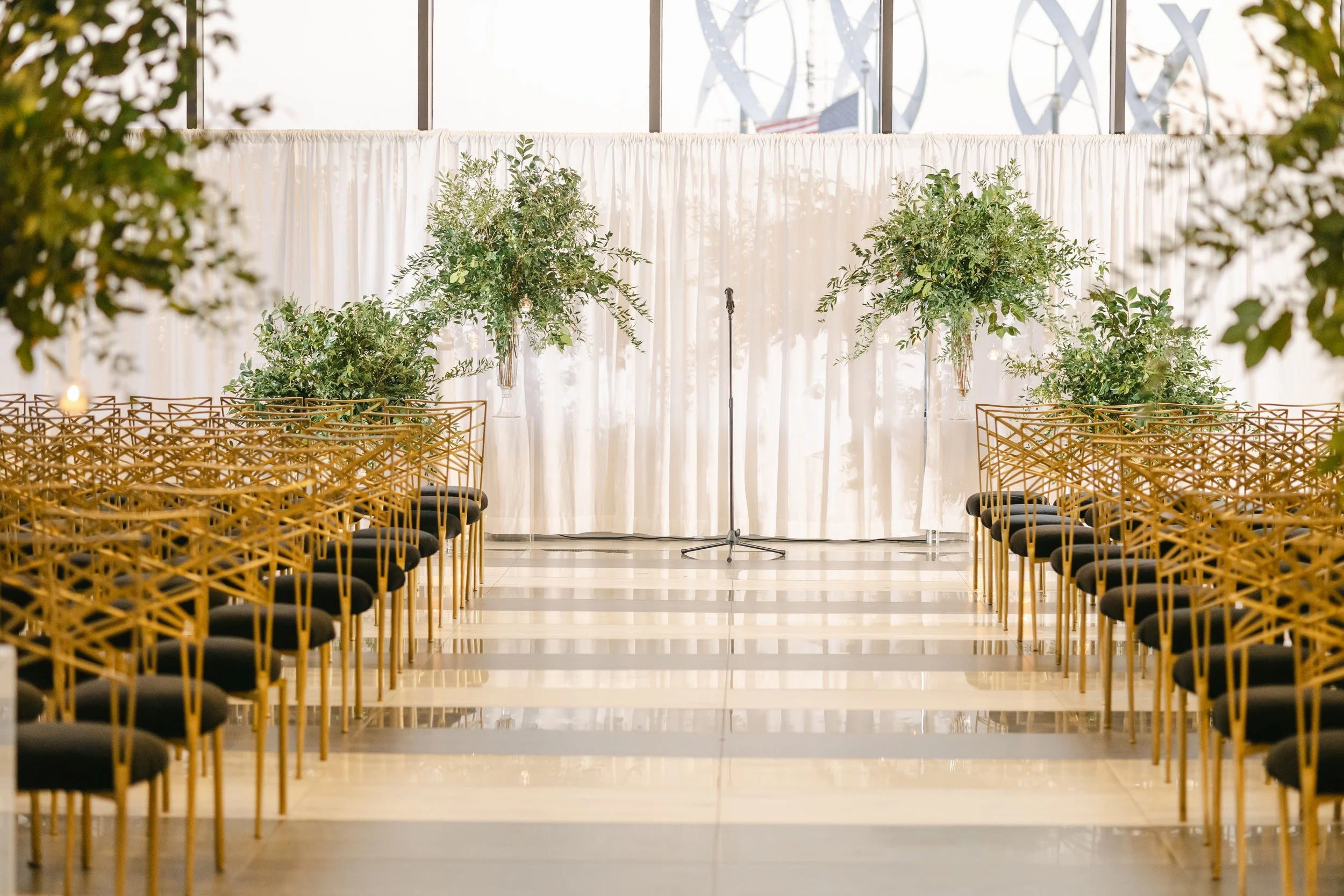
This room already had two statements before we walked in: a floor-to-ceiling view of the water and a gilded branch chandelier strung with hundreds of points of light. An arch would have been a third voice in a conversation that didn't need one.
So we built the altar from tall, loose greenery in clear glass vessels on lucite plinths, set asymmetrically against a soft white backdrop, with floating candles at their feet. The same arrangements repeat down the aisle at the row ends. Gold lattice-back chairs with black seats tie the chandelier to the floor and give the whole room a crisp, graphic edge.
Why it works: The design borrows the architecture instead of competing with it. Guests feel the room first and the florals second, which is exactly the right order here.
The Trade-Off: Without a structure, there's no built-in frame for the couple. The photographer has to find it, and the arrangements have to be placed with precision so the two of you aren't standing in a gap. Height does the work an arch would normally do.
Best for: Venues with a view, a ceiling, or a fixture that's already the star.
2. The Full Circle: White Roses and Hydrangea
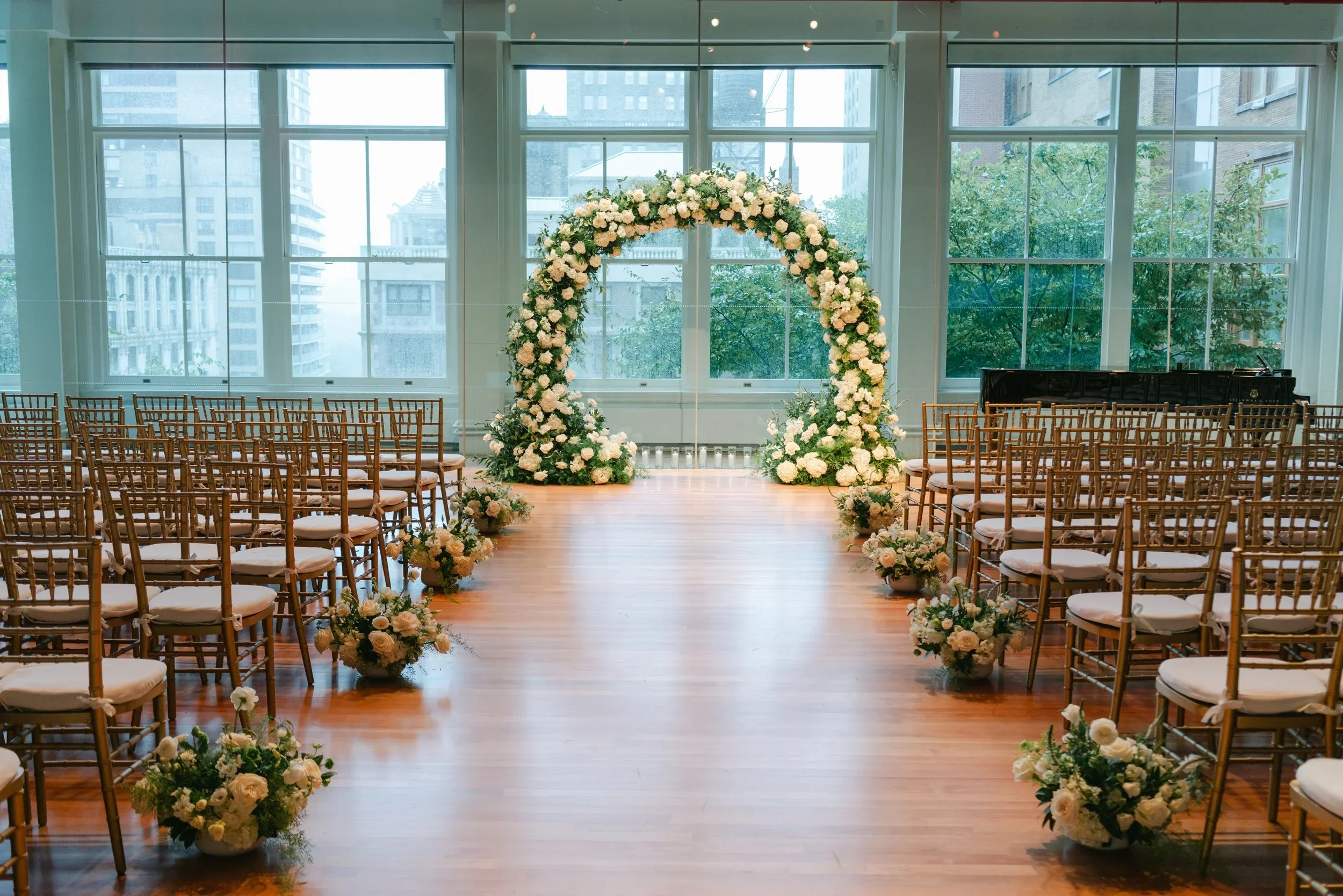
It rained all day. Through the windows, the city went soft and grey, and inside, a full circle of white roses, hydrangea and garden greenery stood in the center of three tall windows.
A circle is the most formal arch shape there is, and it only works when it's grounded. This one is: the base pools into deep, lush clusters on both sides rather than meeting the floor as a thin ring. Low white arrangements in matte bowls step down the aisle, a line of pillar candles runs along the sill behind, and gold chiavari chairs with white cushions keep the palette quiet.
Why it works: The circle centers the couple perfectly, and the window grid behind it gives the geometry something to sit inside. On a grey day, an all-white floral palette glows rather than disappears.
The trade-off: A circle demands symmetry. In a room where the focal point is off-center, or where the windows don't line up, it will look like it landed in the wrong place. It's also one of the heavier pieces to install, and it needs a frame built and weighted for the space.
Best for: Symmetrical rooms, classic palettes, and couples who want a ceremony photo that reads instantly.
3. One Flower, Thousands of Stems: The Baby's Breath Arch
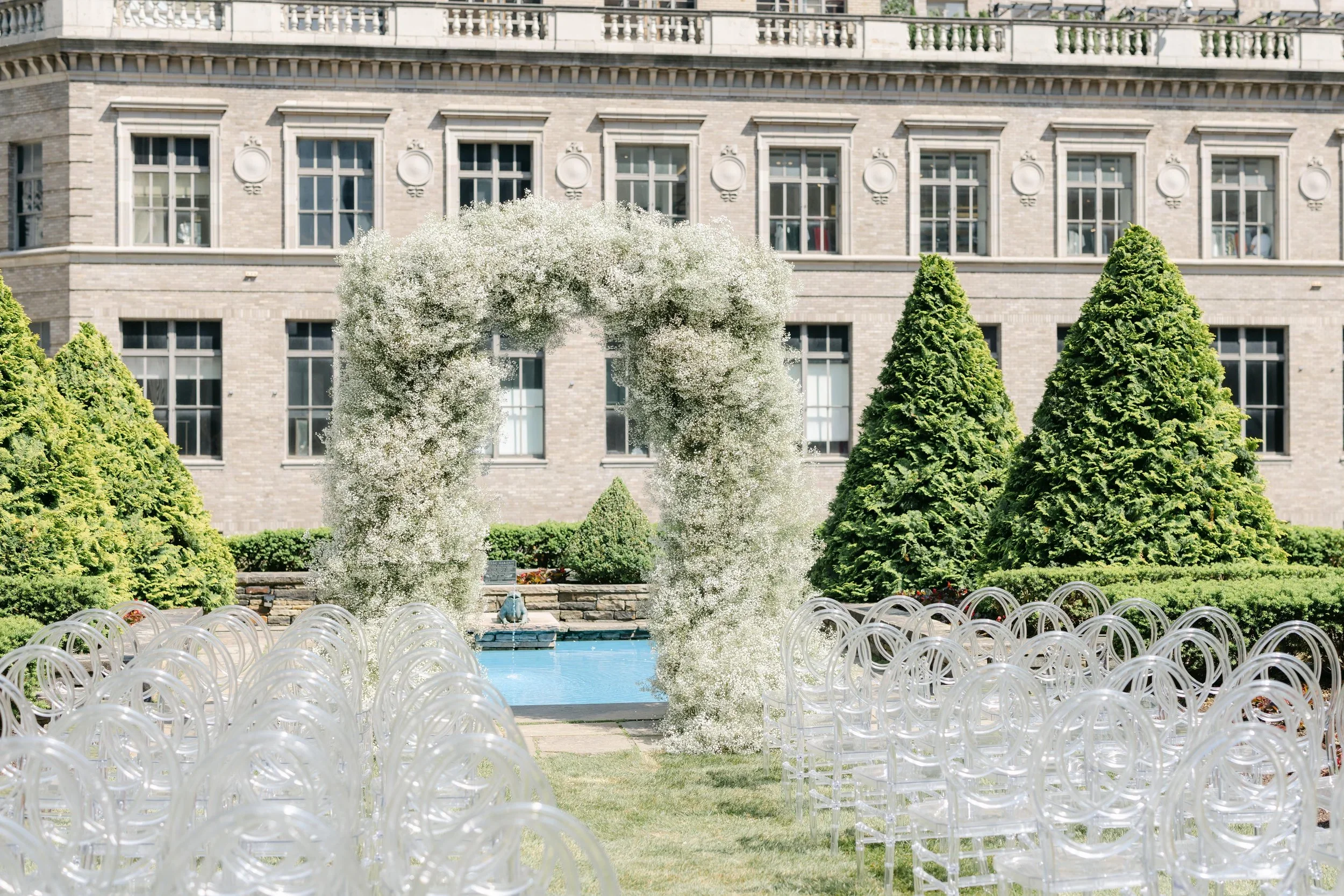
A rooftop garden in Midtown, with clipped conical evergreens, a reflecting pool, and a limestone façade rising behind it. We gave it a single-variety arch made entirely of baby's breath, dense enough to read as a cloud, flanked by rows of clear ghost chairs.
This is restraint at volume. One flower, one color, no greenery to soften it, and the result feels modern precisely because there's nothing else to look at.
Why it works: The garden supplies the green. The building supplies the structure. The arch only has to supply texture and light, and baby's breath does both better than almost anything. The clear chairs keep sightlines open so the arch and the pool read as one composition.
The trade-off: Baby's breath is inexpensive by the stem and expensive by the arch. An installation this full takes a very large quantity and a lot of labor. It also has a distinctive scent that some people don't love, which matters in an enclosed space far more than on an open rooftop. And single-variety design is unforgiving: every gap shows.
Best for: Gardens, rooftops, and any setting that already has plenty of green.
4. The Floating Canopy: A Lucite Chuppah Under Corinthian Columns
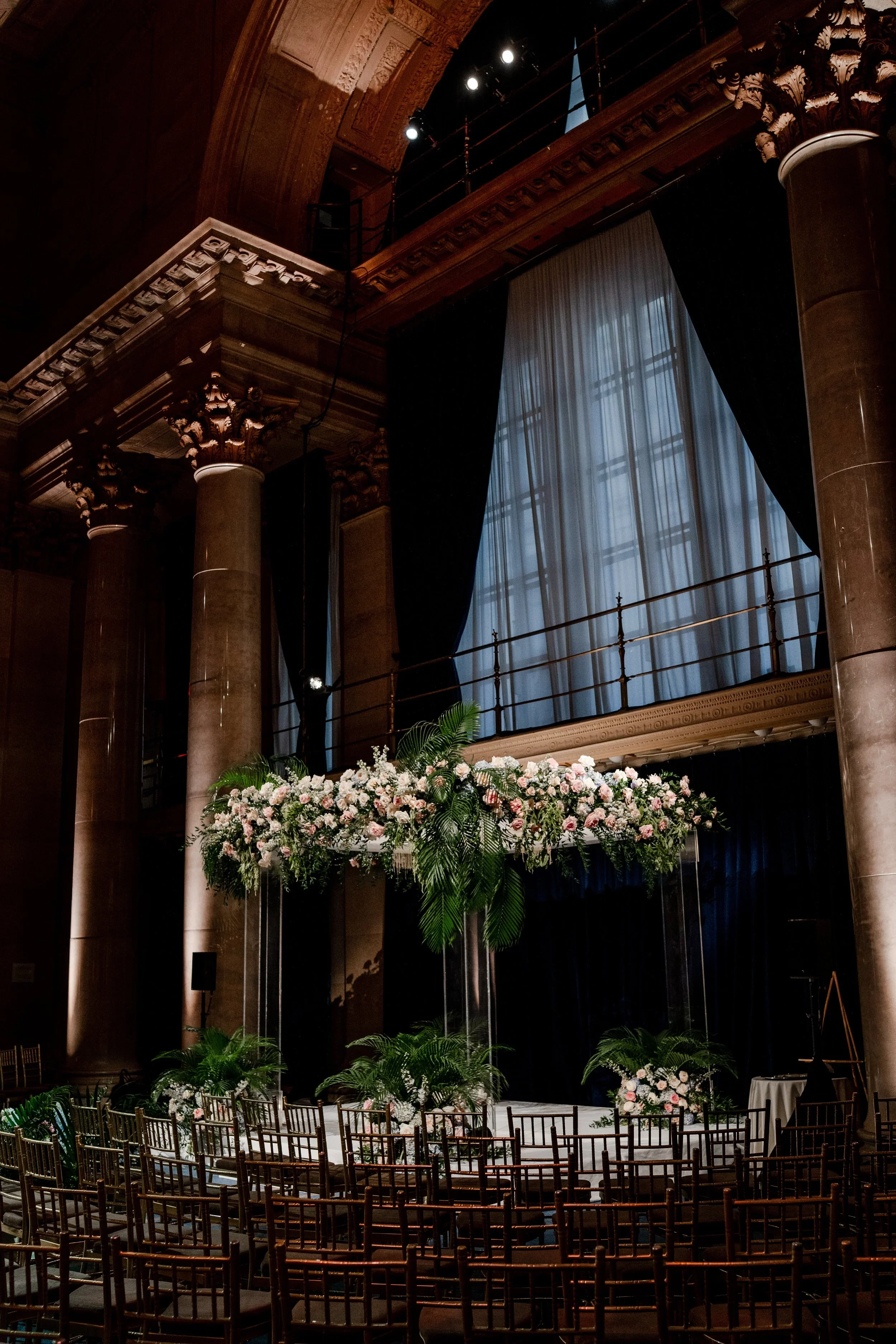
In a hall this grand, with carved capitals, a coffered arch and two-storey drapery, the worst thing you can do is try to match it. We went the other way: a chuppah with clear lucite poles, so the canopy of blush and white roses, pale blue hydrangea and sweeping palm fronds appears to hover in the space.
The palms are the unexpected note. They break up what could have been a very traditional floral line, and they repeat at the base of each pole, so the design reads as one gesture from floor to canopy.
Why it works: The legs disappear, so the eye goes straight to the flowers and to the couple underneath. It respects the room's architecture without competing with a single column of it.
The trade-off: Lucite only disappears with the right lighting. In a dim hall, the canopy needs dedicated pin-spotting, or it falls into shadow, so lighting has to be in the budget from the start, not added later. Lucite also shows every fingerprint and scuff, which means careful handling during load-in.
Best for: Historic ballrooms and grand halls where the architecture is the point.
5. Birch Poles and White Garden Flowers Outdoors
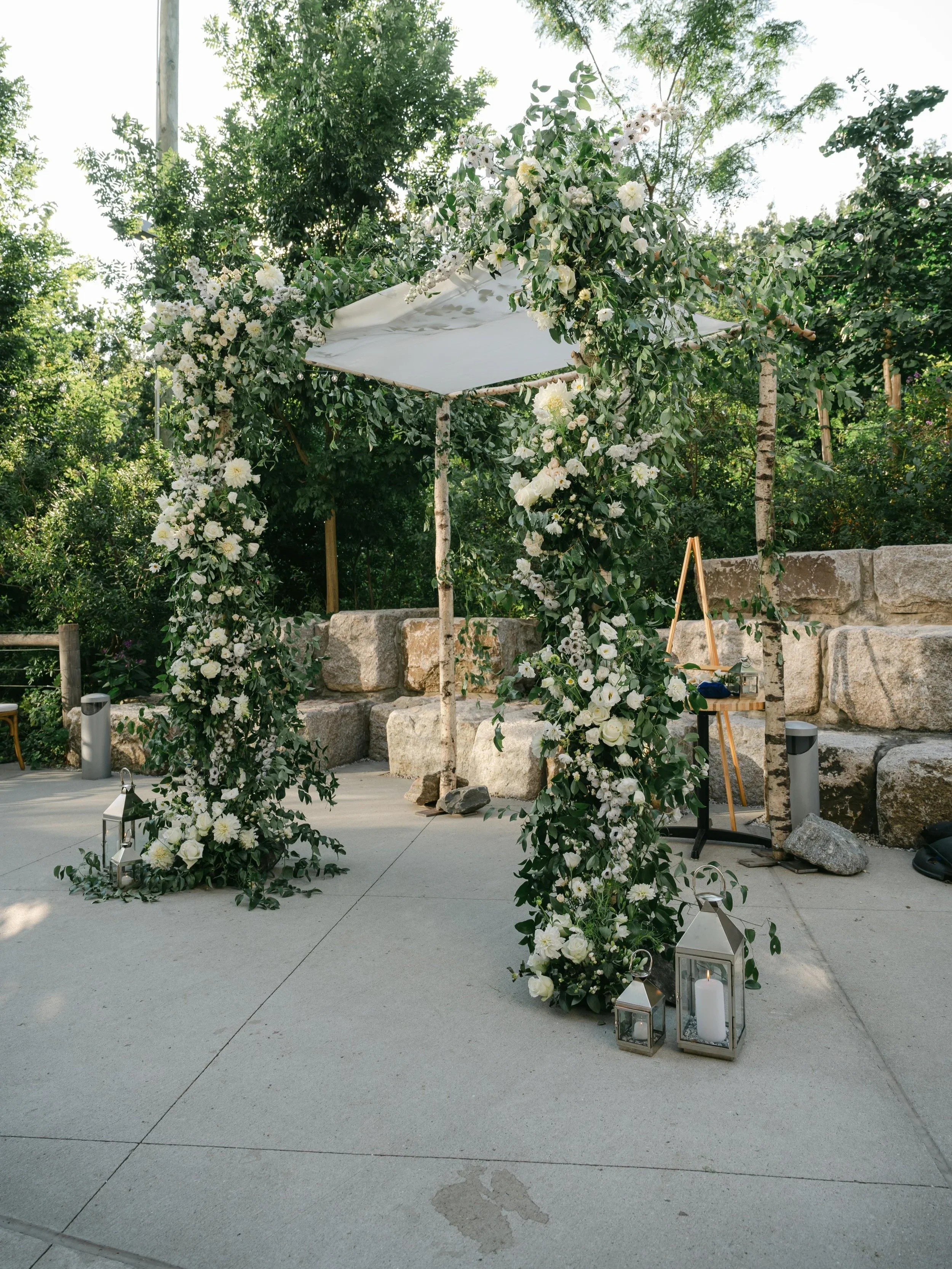
This chuppah stood outdoors, against rough stone terracing and a wall of trees, at golden hour. Four natural birch poles carried a simple white fabric canopy, and the florals climbed two of the poles asymmetrically: garden roses, dahlias, lisianthus and delphinium, wrapped in trailing greenery that spills onto the ground. Silver lanterns with pillar candles sit at the base.
A chuppah is open on all four sides by tradition, and outdoors that openness becomes part of the design. The birch poles belong to the setting, so the structure looks found rather than delivered.
Why it works: Asymmetry keeps it relaxed and lets the canopy stay visible. Dressing all four poles would have closed the structure in and made it feel heavier than the setting wanted.
The trade-off: Outdoors, everything works harder. Florals need varieties that tolerate heat, the structure needs to be weighted against wind, and the lanterns need a plan if a breeze picks up. Your hour of golden light also comes with a firm start time.
Best for: Parks, gardens and waterfront terraces in late spring through early fall.
6. A Chuppah That Looks Grown, Not Built
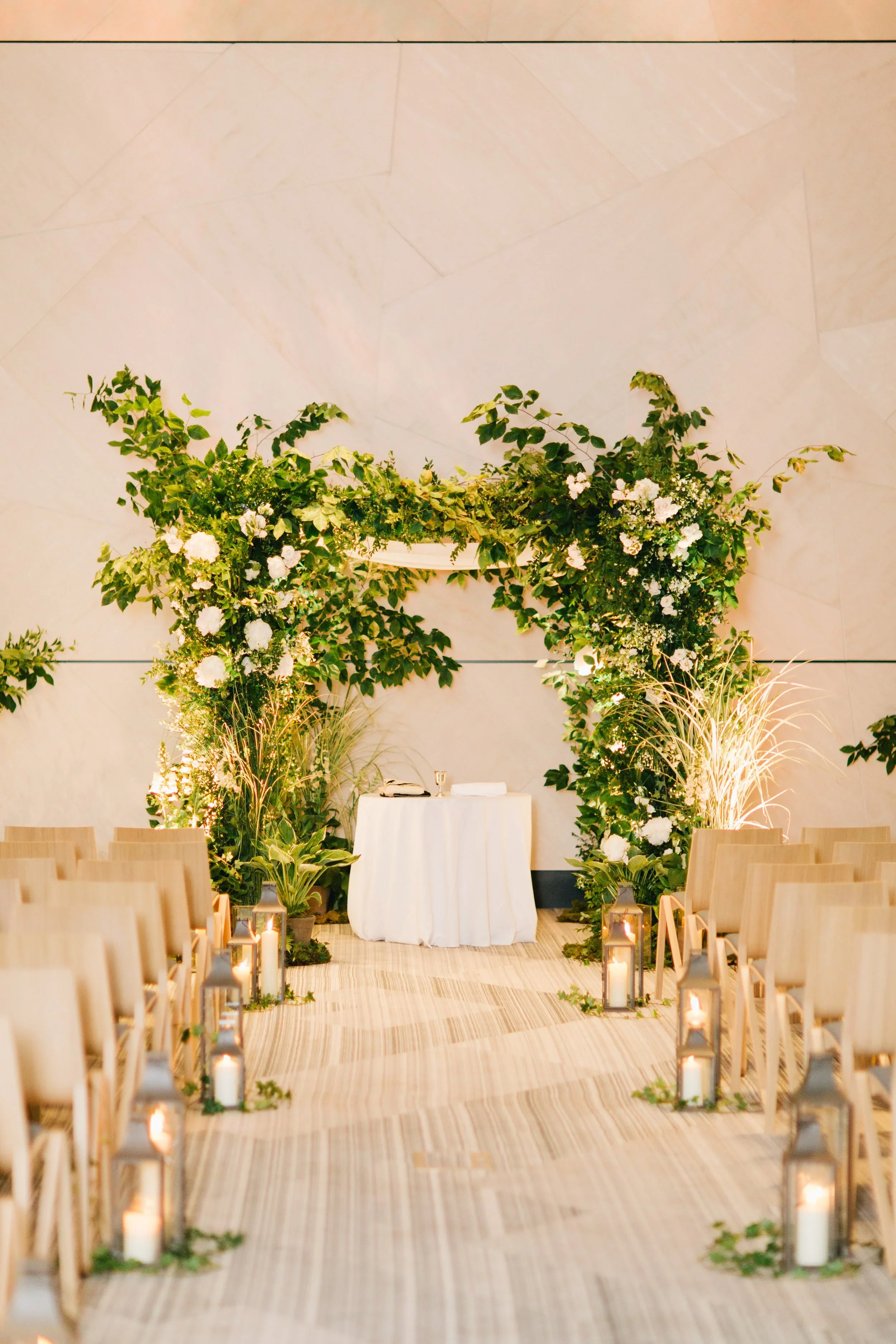
Against a pale stone wall cut into geometric planes, we built a chuppah that looks like it grew there: leafy branches arching overhead, white garden roses tucked into the foliage, tall ornamental grasses and potted hostas at the base, and moss across the floor. A simple swag of white fabric spans the top. Pewter lanterns with ivy line the aisle, and pale wood chairs pick up the warmth of the uplighting.
Why it works: The wall is cool and architectural; the chuppah is wild and organic. That contrast is the whole design. Uplighting through the branches throws shadows onto the stone, so the structure extends beyond its own footprint.
The trade-off: "Effortless" is the most labor-intensive look in floral design. Branches need to be sourced, conditioned and secured so they look loose but stay put, and the look depends on a skilled florist's eye more than on a recipe. It's also harder to describe on a proposal, so trust in your floral team matters.
Best for: Modern, minimal venues that need warmth, and couples who prefer a garden to a bouquet.
How to Choose. Three questions settle most of it:
What's already the star of the room? A view, a chandelier or a column needs a structure that steps back. A blank wall needs one that steps forward.
Is the room symmetrical? Circles and full arches want it. Asymmetric and organic designs forgive a lot.
What does the lighting look like at ceremony time? Lucite, white florals and evening ceremonies all depend on it.
If you're having a Jewish ceremony, there's one more: whether a family tallit or a meaningful textile will form the canopy. That decision shapes everything else, so we make it first.
Frequently Asked Questions
-
An arch is a decorative frame with no fixed form. A chuppah is a canopy held on four poles, open on all sides, and it carries religious meaning in a Jewish ceremony. Many couples who aren't having a Jewish ceremony still choose a four-post structure simply for how it frames the space.
-
Often, yes. Arches and chuppahs can be moved behind a sweetheart table, a band or a bar during cocktail hour. It needs to be planned into the timeline and the florist's staffing, because moving a large piece quickly takes a crew.
-
In grand or architectural rooms, yes. They let the flowers float and keep the room visible. In a plain room, they can feel like something is missing, and they always need good lighting.
-
Not at scale. Per stem it's affordable, but a full installation needs a large volume and significant labor. Its appeal is the look, not the savings.
-
Every outdoor structure should have an indoor placement mapped out in advance, including how it will be moved and who will move it. We decide the rain call time with the venue weeks ahead, not on the morning of.
Read The Full Journal
BJÖRN VW EVENTS · NEW YORK CITY
Let's plan your
perfect day together
From intimate dinners to grand ballroom affairs, we bring decades of New York experience to every celebration. Our vendor network, creative vision, and hands-on approach means you can focus on the moments that matter.
The ceremony structure is the one piece of design every guest looks at, without distraction, for twenty minutes. It's also the piece couples most often choose from a single saved photo, before anyone has asked what the room needs.