
How To Plan a Luxury Wedding in New York City
PLANNING TIPS · BJÖRN VW EVENTS
How To Plan a Luxury Wedding in New York City
By Björn VW · August 2026
New York does not hand luxury to anyone. The city's best venues book eighteen to twenty-four months out, its top florists and photographers carry waitlists, and its logistics — freight elevators, load-in windows, noise ordinances, borough-to-borough transit — punish anyone who treats a five-borough wedding like a destination event in a resort town. A luxury New York wedding is not simply an expensive one. It is one where every friction point the city creates has been anticipated, absorbed, and hidden from the guest experience, so that what remains looks effortless.
This guide walks through the disciplines that make that possible.
Choosing a Venue
Venue selection in New York is really two decisions happening at once: the space itself, and the constraints that come bundled with it. A landmarked property like Cipriani Wall Street or The Plaza carries architectural gravity that needs almost no additional design layered on top of it. A raw industrial space — a Brooklyn warehouse, a Wythe Hotel loft — offers a blank canvas, but that blank canvas comes with a full production build: lighting rig, HVAC considerations, sound treatment, and often a stricter curfew. The questions that actually matter, beyond capacity and price per square foot:
What's the vendor policy? Some venues (many Cipriani properties, for instance) require in-house catering, which limits your culinary direction. Others are fully open, which means you're responsible for building the entire vendor stack from scratch.
What's the load-in and load-out window? In Manhattan particularly, freight elevator access, union labor requirements, and building curfews can compress a florist's install time to a two- or three-hour window. This single detail can eliminate certain design concepts before you've even chosen linens.
Is there a rain plan built into the architecture, or will you be renting a structure? Rooftop and garden venues — 620 Loft & Garden & Rushmore Estate — are extraordinary precisely because they're unpredictable, and a serious planning team will have priced the tent or interior contingency before you fall in love with the view.
Does the room have a strong architectural identity, or a neutral one? Neutral rooms are more forgiving for ambitious design; architecturally distinct rooms reward restraint. A planning team that works across the city regularly — the kind of studio Björn VW Events has built over more than a decade between Manhattan, Brooklyn, and the Hudson Valley — brings something a first-time couple can't easily replicate: a working memory of how a specific room actually performs on a wedding day, not just how it photographs empty.
Guest Experience
Luxury, at the level guests actually feel it, is rarely about the most expensive object in the room. It's about the absence of friction. Guests should never wonder where to go, how long cocktail hour will last, or whether there's a coat check. In a city where a wedding often means guests are navigating an unfamiliar borough, a tight subway system, and surge-priced ride shares, the experience begins well before the ceremony — with clear transportation information, a welcoming arrival sequence, and pacing that never leaves anyone standing in a room with nothing happening. The best New York weddings treat guest experience as a directed narrative: arrival, welcome, ceremony, transition, reception, departure — each beat considered for temperature, sound, sight lines, and idle time. Idle time is the enemy. Any moment where a guest doesn't know what's next is a moment the design has failed them, regardless of how beautiful the room looks.
Floral Design
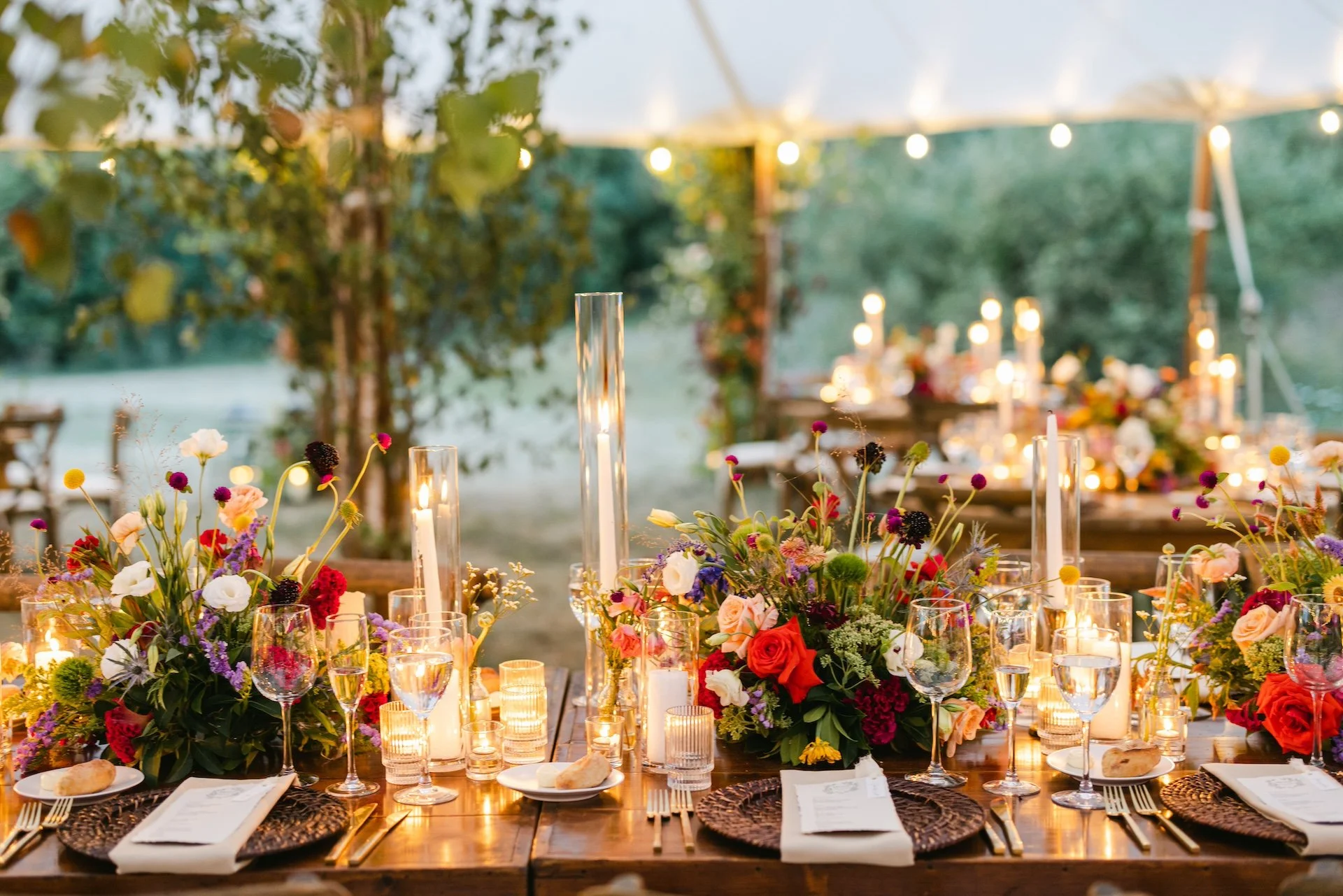
New York floral design at the luxury tier has moved decisively away from matchy, uniform arrangements toward compositions that read as considered and slightly imperfect — garden-gathered rather than florist assembled, even when the sourcing and mechanics behind them are extremely precise. Local, seasonal material (peonies in late spring, dahlias into autumn, anemones and ranunculus in the shoulder seasons) tends to outperform imported stems, both aesthetically and in terms of longevity through a long production day. Scale matters more than most couples expect walking in. A ceremony installation that looks generous in a photo on Instagram can read as sparse in a room with sixteen-foot ceilings, and a florist who hasn't walked the specific venue will often underbid the scale needed. This is one of the clearest cases for pairing a florist with a planner who has installed in that room before — the difference between "enough flowers" and "the right amount of flowers for this ceiling height" is not something a mood board settles on its own. See an example of how we scaled florals for a high-ceiling venue here.
Lighting
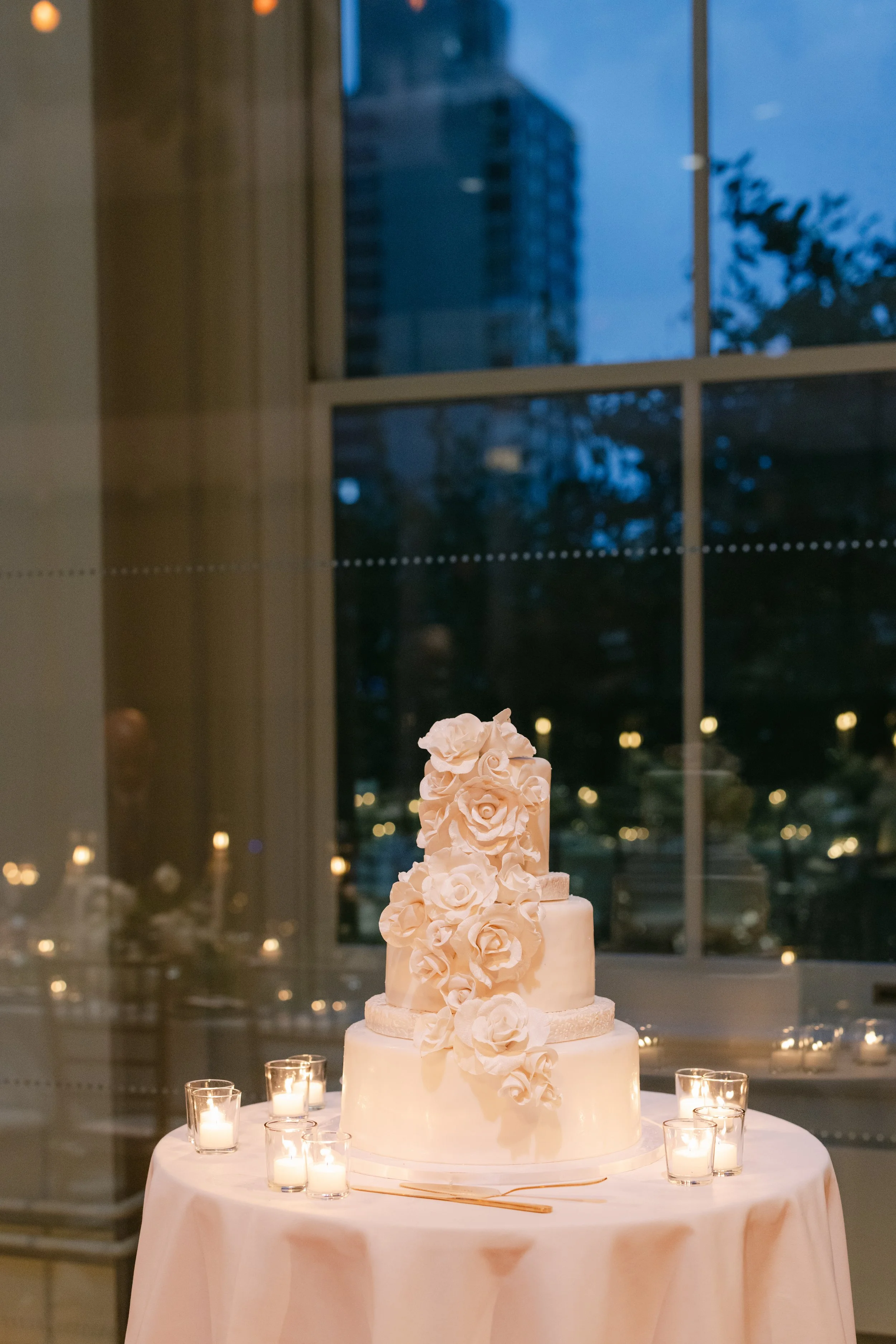
Lighting is the most underrated line item in a New York wedding budget, and the one that separates a room that photographs beautifully from one that merely looks fine in person. Most venues — even the architecturally striking ones — are not lit for evening events out of the box. Uplighting, pin-spotting on florals and cake, a warm wash instead of a venue's house fluorescents, and a dimmable plan that shifts the room's temperature from ceremony to dinner to dancing: these are what make a space feel considered rather than rented. The mistake to avoid is treating lighting as decorative rather than structural. It should be planned alongside the floor plan and the photography timeline, not added afterward, because lighting choices dictate what a camera can actually capture during toasts and first dance.
Stationery
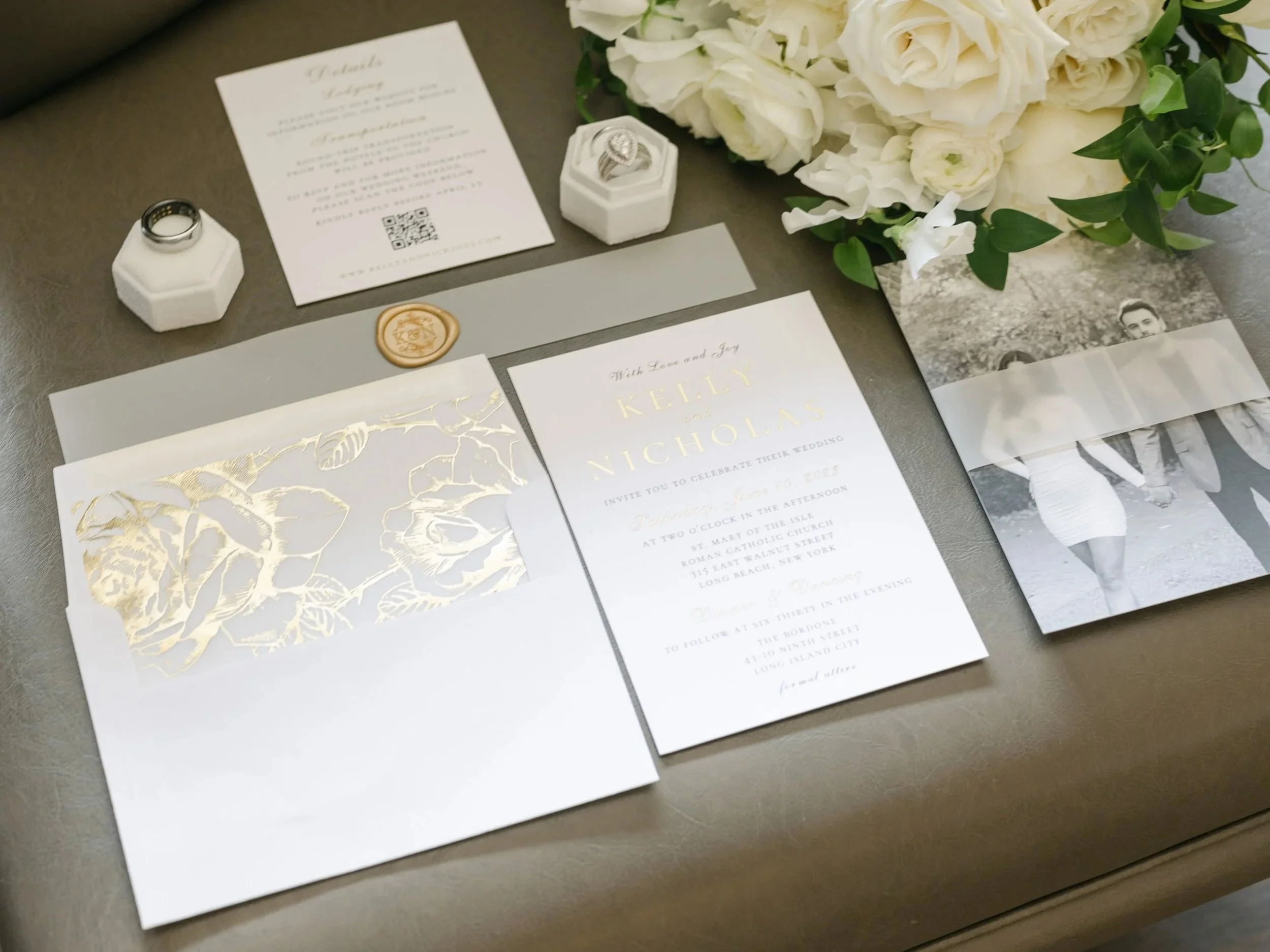
In a city this design-literate, stationery functions as the first tactile signal of the wedding's aesthetic — often arriving in a guest's hands weeks before anything else does. Save-the-dates, invitations, and day-of paper (menus, place cards, programs) should share a coherent typographic and material language, but that doesn't mean identical. The most sophisticated suites vary weight and finish by moment: a heavier, letterpressed invitation; a lighter, more utilitarian day-of program. Custom stationery designers in New York routinely work four to six months out for invitation suites alone, longer if hand-calligraphy or wax seals are involved — a timeline couples frequently underestimate because it sits earlier in the planning arc than the more visible vendors
Entertainment
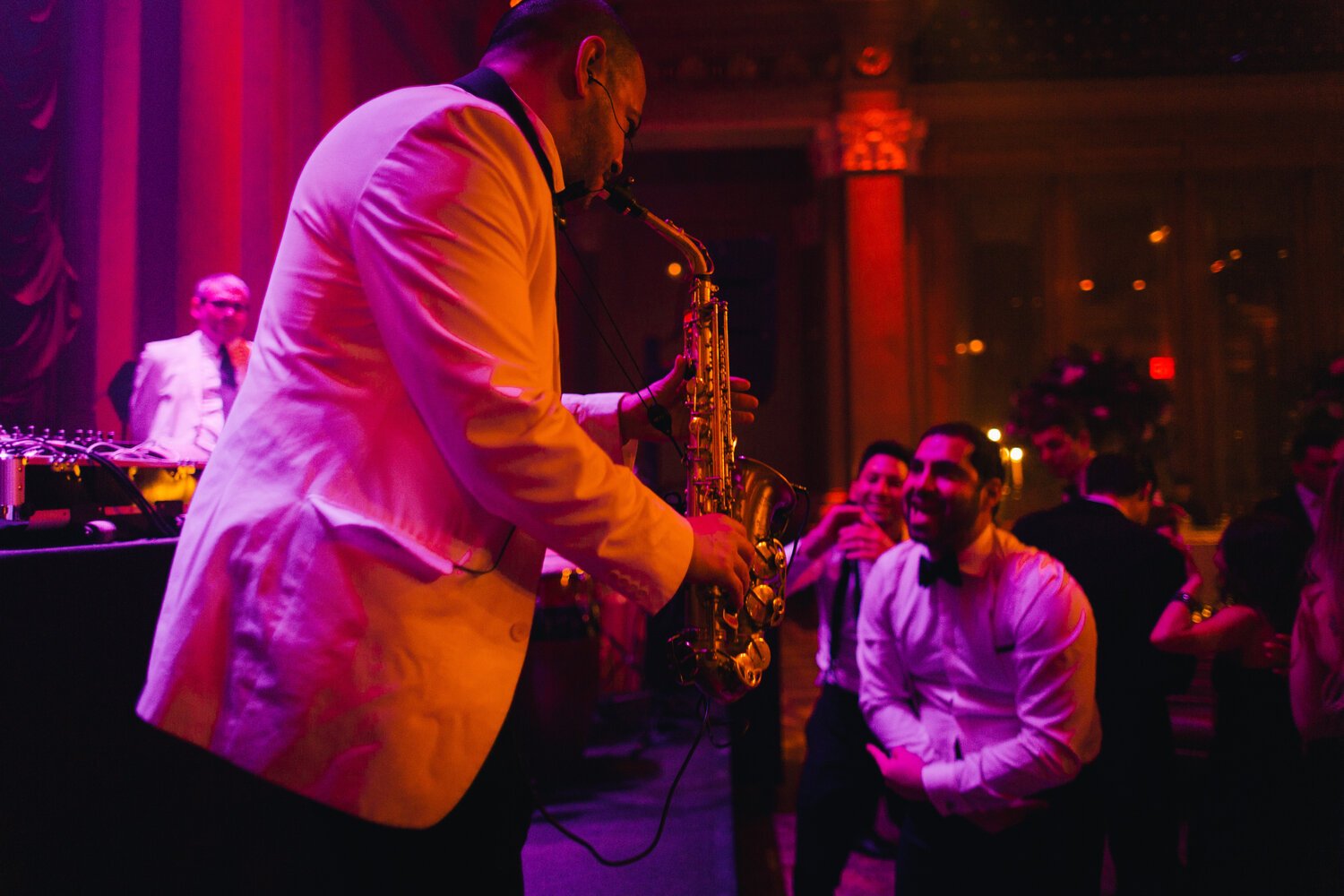
New York's entertainment market is deep, which is both an advantage and a trap. A live band elevates a room's energy in a way a DJ rarely matches, but a full band requires stage real estate, sound treatment appropriate to the venue's acoustics, and — in older or landmarked buildings — sign-off from building management on decibel levels and load-in equipment. A DJ offers more flexibility and a tighter footprint, and increasingly, couples are booking both: a band for dinner and first dances, a DJ to carry the night into its later, louder hours. Ceremony and cocktail hour music is worth its own line of thought. A string trio or solo harpist changes the emotional register of an arrival sequence in a way most couples don't fully register until they hear it.
Catering
New York's culinary talent means catering can be a genuine highlight rather than a formality, but venue vendor policy determines how much control a couple actually has. Exclusive-caterer venues (many Cipriani spaces, several hotel ballrooms) trade flexibility for consistency — the kitchen knows the room. Open vendor spaces allow couples to bring in a specific culinary point of view, but require more diligence: does the caterer have experience in that specific venue's kitchen infrastructure, or lack thereof? Warehouse and loft spaces frequently require a fully mobile kitchen setup, which changes both cost and menu design. Tasting appointments should happen at the venue's actual service temperature and format whenever possible — a plated tasting in a caterer's test kitchen doesn't always predict how a dish holds up after a twenty-minute walk from a mobile kitchen to a rooftop.

Transportation
Transportation is where New York weddings most often go quietly wrong. Between a ceremony in one borough and a reception in another, or a Hudson Valley property an hour outside the city, guest logistics need to be planned with the same rigor as the floor plan. Chartered coaches with clearly communicated pickup windows, mapped against realistic city traffic rather than optimistic estimates, prevent the single most common guest complaint at big-city weddings: standing on a curb not knowing when transport is coming. For the couple and wedding party specifically, timing transportation around photography — not just around the ceremony start time — avoids the scramble that eats into golden hour.
Photography
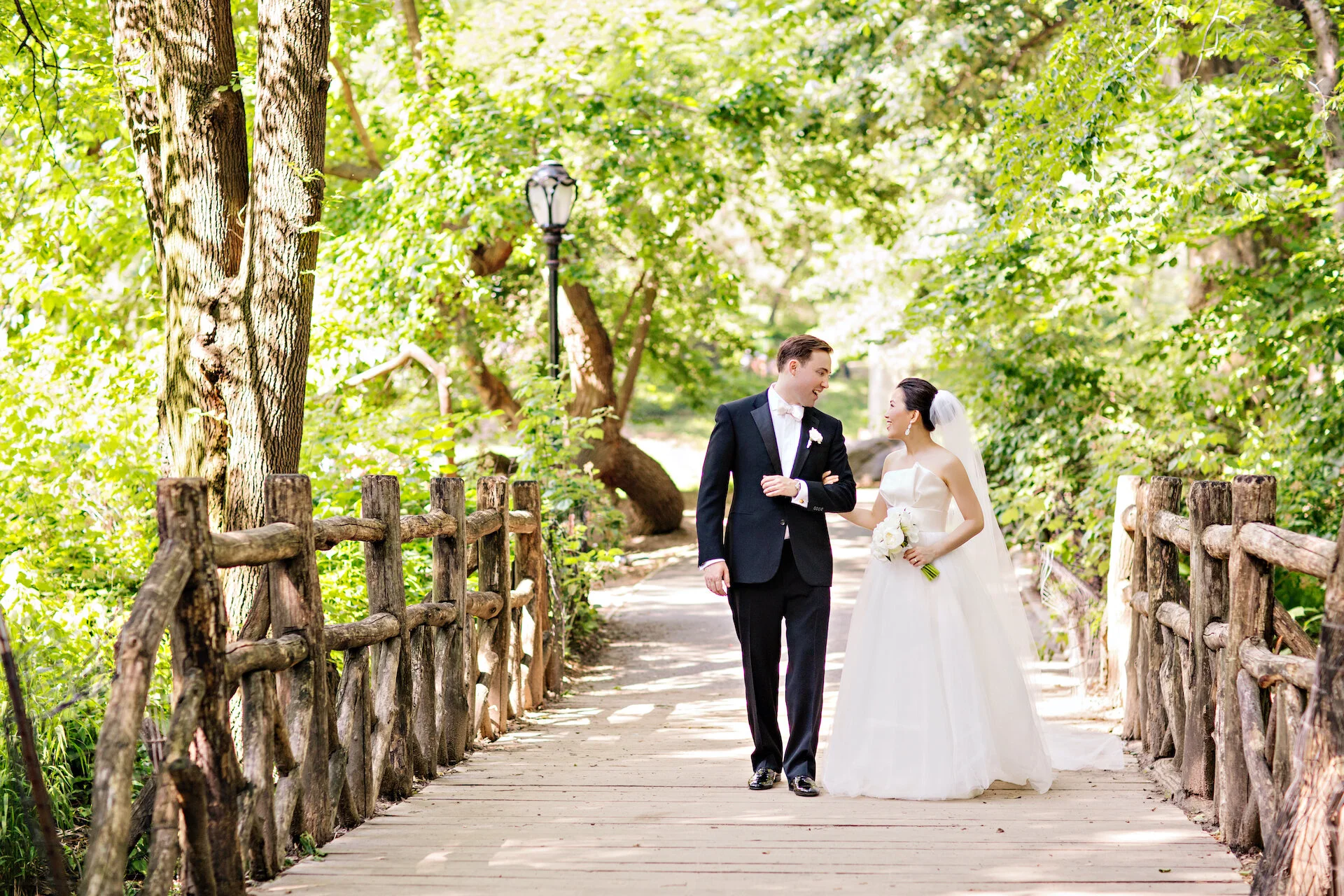
New York's top wedding photographers are usually booked twelve to eighteen months out, and the best pairings come from matching a photographer's existing visual language to the couple's, rather than asking a photographer to bend toward an aesthetic that isn't natural to them. A documentary-leaning photographer and a highly directed, editorial one will produce fundamentally different wedding albums from the identical day — worth resolving in the portfolio review stage, not on the wedding day itself. Timeline design matters enormously here. Golden hour in New York shifts by nearly two hours across the wedding season, and a well-planned timeline builds photography around that light rather than forcing the light to work around a fixed schedule.
Production
"Production" is the catchall for everything that makes the visible parts of the day possible: rigging, power distribution, AV, tenting, generator placement, weatherproofing, and the vendor coordination required to get all of it installed and struck within a venue's often narrow access windows. It's the least glamorous part of a luxury wedding and the part most likely to derail one if under-resourced. In New York specifically, production planning also means understanding union requirements at certain venues, freight elevator scheduling, and building management approval processes that can take weeks to clear. A production timeline built without padding for these approvals is a production timeline that will slip.
Timeline
A luxury wedding's timeline is less a schedule than a piece of choreography — one that reverse-engineers from sunset (for photography), from kitchen fire times (for catering), and from load-in windows (for florals and production), then reconciles all three against each other. The best timelines build in real buffer, not padding that gets quietly eaten by hair and makeup running long, because in a city where every subsequent vendor slot is also tightly scheduled, a fifteen-minute delay at 4 p.m. can cascade into a missed golden hour at 7.
Vendor Management
The single highest-leverage decision in a New York luxury wedding is not the venue or the florist — it's who is managing the relationships between them. A dozen or more vendors, each excellent individually, do not automatically produce a cohesive day. Someone needs to hold the full picture: the florist's install window against the band's sound check, the photographer's shot list against the caterer's service timing, the transportation schedule against the ceremony start. This is the function a planning and design firm like Björn VW Events exists to serve — not as a vendor among vendors, but as the party responsible for making sure every other vendor's excellent individual work resolves into a single coherent event, rather than a series of beautiful but disconnected moments.
Design Cohesion
Design cohesion is what separates a wedding that feels curated from one that feels assembled. It shows up in small alignments: stationery typography echoed in menu cards, a floral palette that shifts logically from ceremony to reception rather than repeating identically, lighting temperature that matches the mood of each phase of the evening. None of these individually reads as significant to a guest. Together, they're the difference between a wedding that feels directed by a single point of view and one that feels like a collection of vendor deliverables placed in the same room. This is also where restraint earns its keep. The most sophisticated New York weddings are rarely the most maximal ones — they're the ones where every design element serves the same narrative, and nothing is included simply because it was available.
Common Mistakes
A few patterns recur often enough to be worth naming directly: Booking the venue before understanding its constraints. Falling for a room without asking about load-in windows, vendor policy, or curfew leads to expensive redesigns later.
Underestimating lighting and production as line items. These are frequently the first to get cut and the most consequential to a room's final look.
Building the timeline around the ceremony time instead of the light. Golden hour should anchor the schedule, not the other way around.
Treating stationery as a late-stage errand. Custom suites need lead time that competes with, not follows, the rest of the planning calendar.
Underbuying floral scale for the room's ceiling height. What looks generous on a mood board often reads as sparse in a room with real architectural volume.
Assuming vendors will coordinate themselves. Individually excellent vendors still need a single point of coordination — without one, even a well-chosen vendor roster can produce a disjointed day.
Skipping a realistic transportation plan for guests moving between boroughs or into the Hudson Valley, which is one of the most common sources of guest-side complaints at otherwise flawless weddings.
The Throughline
Every discipline above is solvable on its own. What's harder — and what actually defines a luxury New York wedding — is solving all of them at once, in a city that offers very little margin for improvisation. That coordination is less a matter of taste than of infrastructure: knowing which rooms perform well under which lighting, which caterers thrive in mobile kitchens, which florists scale correctly for a given ceiling height, and how all of it needs to be sequenced against a single day's clock. Studios that work this way consistently — Björn VW Events among them, with over a decade spent planning and designing across NYC and the Hudson Valley — tend to describe their aesthetic as something like "simple modern elegance": restraint as a design principle, not an absence of ambition. In a city that rewards spectacle by default, that restraint is often the more difficult, and more luxurious, choice.
Read The Full Journal
BJÖRN VW EVENTS · NEW YORK CITY
Let's plan your
perfect day together
From intimate dinners to grand ballroom affairs, we bring decades of New York experience to every celebration. Our vendor network, creative vision, and hands-on approach means you can focus on the moments that matter.
New York does not hand luxury to anyone. The city's best venues book eighteen to twenty-four months out, its top florists and photographers carry waitlists, and its logistics — freight elevators, load-in windows, noise ordinances, borough-to-borough transit — punish anyone who treats a five-borough wedding like a destination event in a resort town.